
Why This Slide Is Useful
This slide is valuable for senior leaders and strategy teams as it offers a clear visualization of the design thinking process, which is essential for innovation and problem-solving initiatives. It helps executives understand how divergent thinking broadens the scope of exploration, while convergent thinking narrows focus to actionable solutions. This clarity supports better resource allocation and decision-making during project planning or transformation efforts.
For management consultants and strategic advisors, the framework provides a common language for guiding client teams through complex problem-solving exercises. It enables the facilitation of workshops, ensuring participants follow a disciplined process that balances creativity with structure. The visual nature of the slide makes it easy to communicate progress and align stakeholders on the iterative nature of design thinking.
The slide also serves as a diagnostic tool to assess where a project or team might be stuck in the process. For example, if a team is overly focused on broad exploration without narrowing down ideas, it signals the need to shift toward defining specific problems. Conversely, if solutions are being developed prematurely, it indicates a lack of sufficient insight or ideation phases.
In addition, this framework supports innovation initiatives by encouraging a disciplined yet flexible approach to idea generation. It reminds leaders that effective problem-solving involves moving back and forth between divergent and convergent thinking, rather than following a linear path. This understanding helps in designing more effective innovation pipelines and managing stakeholder expectations.
How This Slide Is Used
This slide is typically used in innovation workshops, design sprints, or strategic planning sessions. Facilitators leverage it to guide teams through the stages of problem exploration and solution development, ensuring a balanced approach. It is often employed at the beginning of projects to set expectations around the iterative nature of design thinking.
Consultants customize the slide by highlighting specific activities or deliverables associated with each phase. For example, during the Discover stage, teams might conduct user interviews or market research, while the Define phase involves synthesizing insights into clear problem statements. The Develop phase focuses on brainstorming and prototyping, culminating in the Deliver stage where solutions are tested and implemented.
In client presentations, the slide helps communicate the methodology behind innovation initiatives. It demonstrates a disciplined process that mitigates risks associated with jumping to solutions too quickly. This visual also supports stakeholder buy-in by illustrating how ideas are refined through multiple iterations before final implementation.
Organizations often use this framework to structure project timelines and milestones. For example, a product development team might allocate specific sprints to each phase, ensuring thorough exploration and validation. The slide also functions as a progress tracker, with teams marking completed stages and identifying areas needing further iteration or refinement.
Finally, the Double Diamond framework is useful for training new team members or fostering a shared understanding of the innovation process. Its visual simplicity makes it accessible across functions, encouraging cross-disciplinary collaboration and a common language for problem-solving efforts.
Related PPT Slides

Design Thinking Process Overview PPT Slide
This slide illustrates the structured five-phase approach of the design thinking methodology, emphasizing its application across 3 different spaces. It visually maps the progression from inspiration through ideation to implementation, highlighting key activities within each phase. The diagram supports understanding of how iterative steps lead to the development of a final product.

Design Thinking Process Overview PPT Slide
This slide illustrates the stages within the design thinking methodology, emphasizing perspective-taking and problem framing through metaphorical thinking hats. It highlights 5 key phases—Discovery, Interpretation, Ideation, Experimentation, and Evolution—each supported by visual icons and guiding questions to facilitate understanding and application in innovative problem-solving.

Product Development Pyramid PPT Slide
This slide illustrates a hierarchical framework for advancing through stages of product development, from initial market fit to proof of concept. It visually segments each phase with distinct colors, icons, and descriptions, providing a clear roadmap for managing innovation processes and aligning team efforts.

Design Thinking Process Overview PPT Slide
This slide illustrates the non-linear, iterative nature of the design thinking methodology, emphasizing 5 key phases that promote user-centered innovation. It visually maps each phase—Empathize, Define, Ideate, Prototype, and Test—using hexagonal icons and describes their core activities. The process is supported by a simplified flow of Understand, Explore, and Materialize, guiding strategic problem-solving efforts.

Core Traits of Design Thinkers PPT Slide
This slide highlights 5 essential personality characteristics that underpin effective design thinking. It visually maps each trait—Empathy, Experimentalism, Collaboration, Optimism, and Interactive Thinking—and provides brief descriptions to emphasize their importance in innovative problem-solving processes. The layout supports quick comprehension for strategic or leadership audiences involved in fostering creative cultures or managing innovation initiatives.

Digital Maturity Model Progression PPT Slide
This slide illustrates a seven-phase framework for advancing digital maturity, mapped along a progression from initial exploration to strategic improvement. It emphasizes the movement through crawl, walk, and run stages, with each phase representing a step toward increasing strategic value through digital initiatives. The visual highlights key activities and the corresponding maturity levels, providing a clear pathway for digital transformation efforts.
Explore Slides by Tags

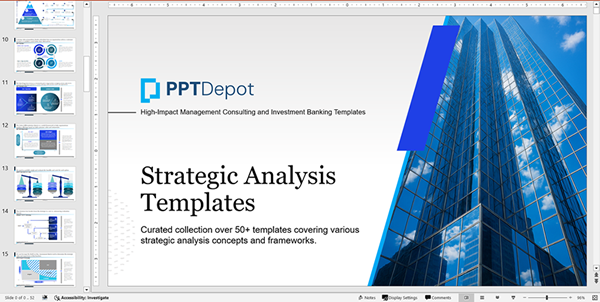
Download our FREE collection of over 50+ high-impact, fully editable PowerPoint templates. These professional templates cover a comprehensive range of strategic analysis frameworks—including Strategy Formulation, Innovation, Digital Transformation, Change Management, and many others—ideal for Management Consultants, Investment Bankers, Strategy Professionals, and Business Executives.
Trusted by Leading Global Organizations
Our templates are trusted by thousands of organizations worldwide, including leading brands such as those listed below.






























Related Templates from PPT Depot










Leverage our domain and design expertise. Become a subscriber today:
Each presentation is available in 3 color schemes. Download the version that most fits your firm's branding and customize it further once you download the PPTX file.
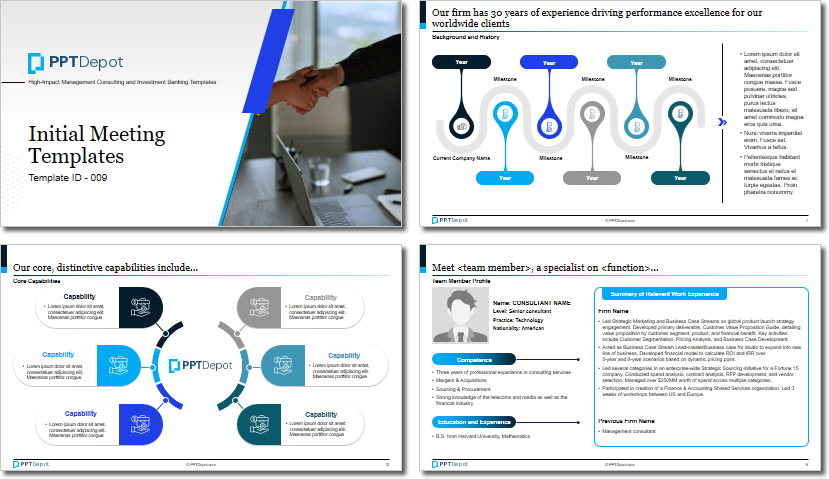
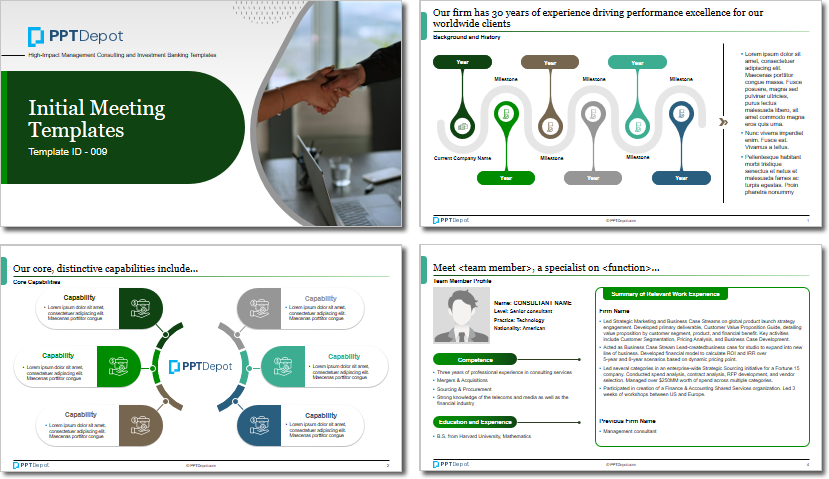
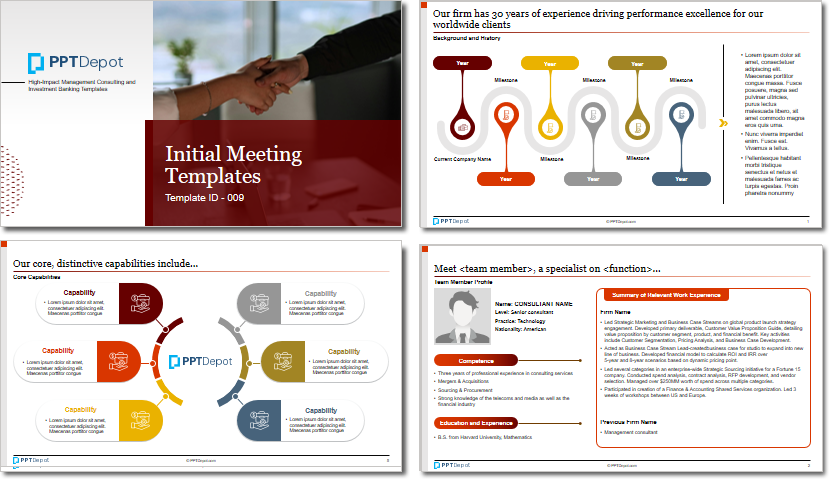


PPT Depot is your subscription to high-impact management consulting and investment banking templates—crafted from real-world deliverables by ex-MBB consultants and designed by former McKinsey Visual Graphics (VGI) presentation specialists. Compare plans here to determine what's the best fit for your firm.
With 15 years of experience, the team behind PPT Depot has empowered over 500+ clients across over 30+ countries. We currently produce 200,000 slides annually.
PPT Depot releases new templates each week. We have management topic-focused templates (e.g. market analysis, strategic planning, digital transformation, and more), alongside industry-specific collections. Peruse our full inventory here.
Save time and effort—elevate your presentations with proven domain and design expertise.
Got a question? Email us at [email protected].
Related Consulting Presentations
These presentations below are available for individual purchase from Flevy , the marketplace for business best practices.

Slide Customization & Production
We provide tailored slide customization and production services:
- Conversion of scanned notes into PowerPoint slides
- Development of PowerPoint master template
- Creation of data-driven PowerPoint charts from hand-drawn graphs
- Conversion of Excel charts to PowerPoint charts
- Conversion of other file formats (e.g. PDF, TIF, Word Doc) to PowerPoint slides
- Conversion of PowerPoint slides from one master template to another
- Visual enhancement of existing PowerPoint presentations to increase the professional look of the presentation


